
Visit to HM Coastguard’s Joint Rescue Coordination Centre – a fascinating insight
22 members of Oxted Offshore and Ashdown Sailing Club gathered in Fareham on Thursday, 16 October for a tour of HM Coastguard’s Joint Rescue Coordination Centre. Located at the end of a business park near Titchfield, with not even a glimpse of the sea, it was immediately obvious that this was no ordinary Coastguard lookout!
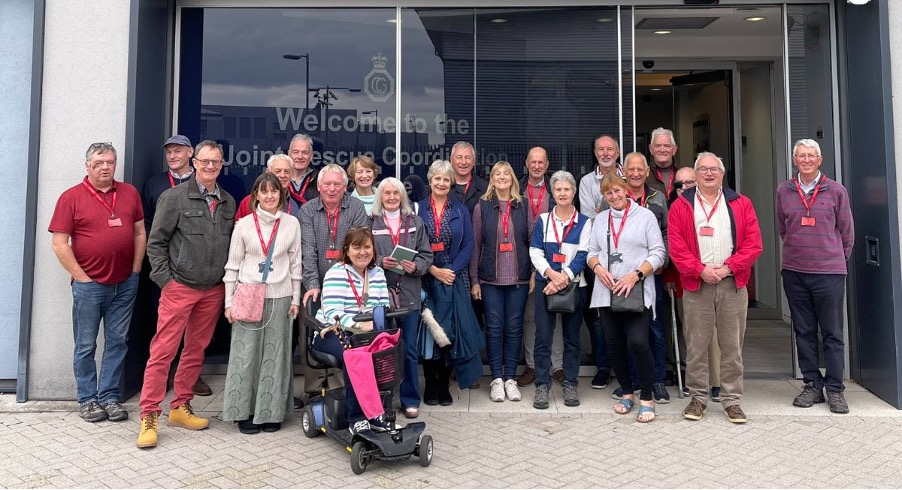
We were met by Maritime Operations Officer Katie, who took us upstairs to a large meeting room and gave an excellent presentation about the operation and their critical role. We were aware of the birds-eye view of the “command centre” below us, but the blinds were drawn and we had to wait!
It’s quite difficult to summarise what happens in Fareham, but essentially they co-ordinate and deploy all the resources needed to respond to every distress call for help at sea, or inland emergencies such as flooding, major pollution or lost contact with an aircraft. Calls to Coastguards or 999 are directed into the JRCC, but they also receive alerts via satellite from DSCs and MayDay calls, or via EPIRBs, MOBs, PLBs, SARTs and ELTs. They receive direct requests for help from the police, ambulance and fire services, and even Border Force, the military and other specialist agencies.
The JRCC’s specialist functions include long-range search and rescue over 1.24 million square NM, covering the mid-Atlantic from where it meets Canadian and Portuguese borders. They are able to monitor any UK registered vessel in distress anywhere in the world, communicating with local rescue services if needed. And they are home to the Strategic Planning Room used for major strategic or security incidents.
The JRCC has just 96 staff split into four teams who work 12-hour shifts and cover maritime, aviation and mission control. Maritime Operations Officers like Katie qualify after 16 weeks of training and are supported by Senior Operations Officers, Network Commanders and, at the top, an Operations Manager. Each rank is identified by insignia, rather similar to the Royal Navy.
The centre has an impressive range of resources in its arsenal. As well as its own all-weather craft, it triggers deployment of the 450+ lifeboats maintained by the RNLI and other charities. The Coastguard Rescue (the “boys in blue”) has 294 teams of 3,000+ volunteers and 106 full time officers. Each team is trained to deal with location specific conditions from mud to dangerous cliffs and rocks.
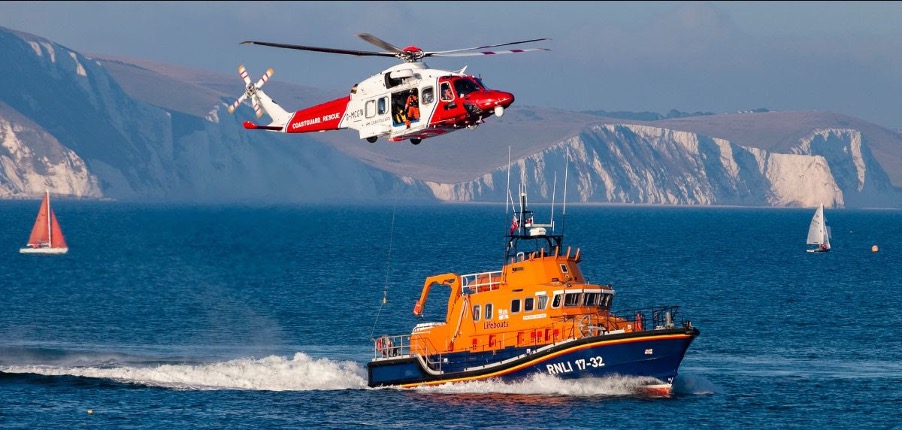
The Aeronautical Operations includes 10 helicopter bases, each with two “welcome sight” red and white search and rescue craft. Their air base at Lydd in Kent operates four Schiebel S-100 drones used to provide real-time, live data and situational awareness to command centres. HM Coastguard also uses fixed-wing aircraft to support maritime search and rescue and counter-pollution missions. These are contracted through commercial companies.
Co-ordinating all this is surely a huge responsibility for the teams at Fareham? So when it came to “any questions” at the end of Katie’s presentation there were plenty. She was quizzed on everything from the technicalities of satellite communications to drug smuggling, and she answered our questions with great expertise! These are a few of the many things we learned:
- The UK was the first ever nation to successfully commission a Hybrid MEO/LEO Antenna. This is a system that combines technologies to seamlessly switch between Low-Earth Orbit (LEO) and Medium-Earth Orbit (MEO) satellites for more reliable, high-performance connectivity.
- Even RNLI volunteers’ pagers are triggered from Fareham.
- Requests for Ch16 radio checks from leisure craft are dealt with at the JRCC, and they are very happy to oblige unless they are up to their eyes in an emergency. What many of us present didn’t know is that you can also call CH67 for a radio check in the Solent, or CH65 for a radio check anywhere in UK waters.
- The Round the Island Race is usually a busy day for the JRCC! This year they brought in 8 additional staff to deal with the MoBs, radio checks and incidents, but all went smoothly.
- The JRCC provided support for Border Force in Kent who received a tip-off via local police about a yacht arriving regularly at night with illegal drugs. HM Coastguard’s knowledge of viable mooring locations enabled Border Force to be ready and waiting when the yacht paid its final visit!
- You can call 999 and ask for Coastguard – JRCC encourage people to do this.
- The JRCC works with numerous commercial partners and agencies, including Garmin who share details of their registered personal location devices for sports, marine and aviation activities.
- The JRCC is the only emergency service where the assigned officer stays with the rescue or incident from beginning to end.
- 10 March this year was a busy day for the JRCC when the container ship MV Solong, travelling at 16.4 knots and with a cargo of alcohol, struck the super tanker Stena Immaculate at anchor off Grimsby. Stena Immaculate was transporting 220,000 barrels of aviation fuel for the US Air Force. Both vessels caught fire. The JRCC deployed RNLI crews from Bridlington, Mablethorpe, Skegness and Cleethorpes, plus a crew transfer vessel, a search and rescue helicopter and a fire-fighting aircraft.
At the end of the session Katie rolled up the blinds to reveal the activity in the control room below. Each work station had four sizeable monitors feeding different data for each incident and we noticed familiar navigation charts on some. It didn’t appear to be the busiest day of the year but you could sense that everything was incredibly well organised and under control. On reflection it was reassuring to see that what could be a life-or-death scenario for somebody out there was being handled in a calm and well-rehearsed way by skilled and highly experienced officers.
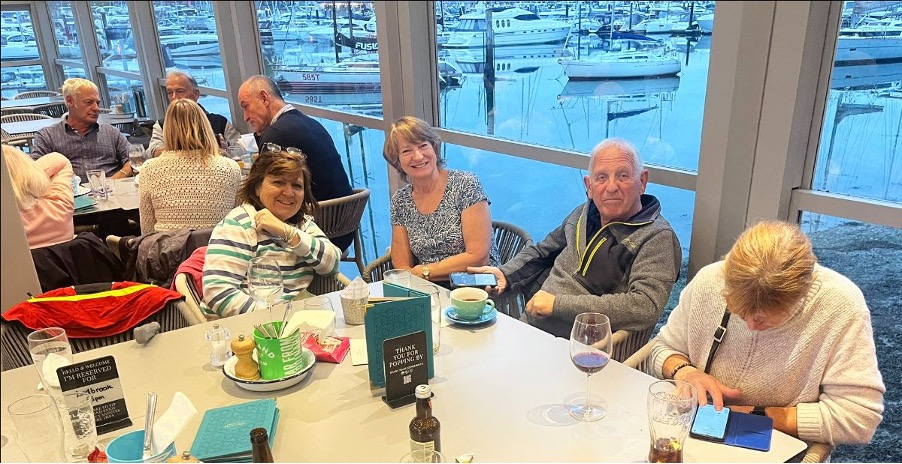
The afternoon ended with an early supper at The Jolly Sailor on the waterfront in Bursledon, organised by Kevin Ludbrook. We had exclusive use of their lovely enclosed seating area (with heaters) perched on the pontoon. A great venue, excellent food and the perfect end to a fascinating day!
UK Coastguard coordinates Falklands sailor rescue
A few days after our visit Jeremy Taylor spotted this report on BBC News:
“A solo yachtsman who survived a night in a damaged vessel in the South Atlantic has thanked coastguards 8,000 miles away in the UK for co-ordinating his rescue. Steve Winn was sailing to Chile from the Falkland Islands on 17 September when his yacht collided with an object, thought to be a shipping container, in Argentinian waters. The islands’ maritime authority notified the Joint Rescue Co-ordination Centre in Fareham, Hampshire, which contacted co-ordination teams in Argentina and Spain. Working together, they located the yacht 108 nautical miles (200km) south-west of the islands. Mr Winn was taken back to Stanley by a fishing trawler.”